
Winning Website Design in Clarence-Rockland: Trust Is the First Transaction
You've built a business, secured your domain, and your site is live. But the phone isn't ringing as often as it should. In a tight-knit market like ours, your digital presence often serves as the first handshake before a customer ever walks through your door. If that handshake feels limp or confusing, you lose the sale before you even know it existed. This isn't usually a traffic problem. It's a trust problem.
Most local business owners assume their site needs to be flashier to work. In reality, conversion issues stem from a lack of clarity and structure, not a lack of animation or expensive photography. When we analyze website design in Clarence-Rockland, we consistently see sites that look "fine" aesthetically but fail to guide the visitor toward a decision. Here's why your digital foundation might be crumbling quietly, and how to fix it without tearing everything down.
Why that first glance decides everything
You don't have the luxury of time when a potential client lands on your URL. Research from Google confirms that users form an opinion about your website in approximately 0.05 seconds (50 milliseconds). That's faster than the blink of an eye. In that fraction of a second, the visitor's brain makes a subconscious judgment: "Is this credible, or should I leave?"
This snap judgment is rooted in the psychology of visual credibility. If your layout shifts unexpectedly, your fonts are inconsistent, or your loading time drags beyond 2.5 seconds, trust evaporates immediately. Stanford University's Web Credibility Research found that 75% of users admit to making judgments about a company's credibility based on their website's design alone. In the context of Clarence-Rockland website design, where local competition is fierce, failing this split-second test means sending your potential revenue directly to a competitor.
The 5 things quietly killing trust on your website
Most trust-killing elements aren't obvious errors. They're subtle friction points that accumulate until the user abandons the page. When we audit local sites, we look for specific "leaks" in the user journey.
1. Looking exactly like the template next door
Using a generic template might seem cost-effective, but it often signals a lack of permanence. When your site uses the same stock layout as five other businesses in Ontario, you commoditize your service. Technical rigidity is also a factor. Many "do-it-yourself" platforms load unnecessary code bloat, slowing down mobile performance. A site that looks temporary suggests a business that might be temporary. You don't need a $10,000 custom art piece, but you do need a distinct visual identity that separates you from the "default" look of a template.
2. Visitors can't figure out what you do in 3 seconds
The "Grunt Test" is a marketing standard: Can a caveman look at your site for 3 seconds and grunt what you do? If your hero section (the top part of your homepage) is filled with vague slogans like "Excellence in Service" rather than "Emergency Plumbing in Rockland," you're losing leads. Data shows that clear, descriptive headlines outperform creative or abstract ones by 20-30% in conversion tests. Your value proposition must be explicit and visible without scrolling.
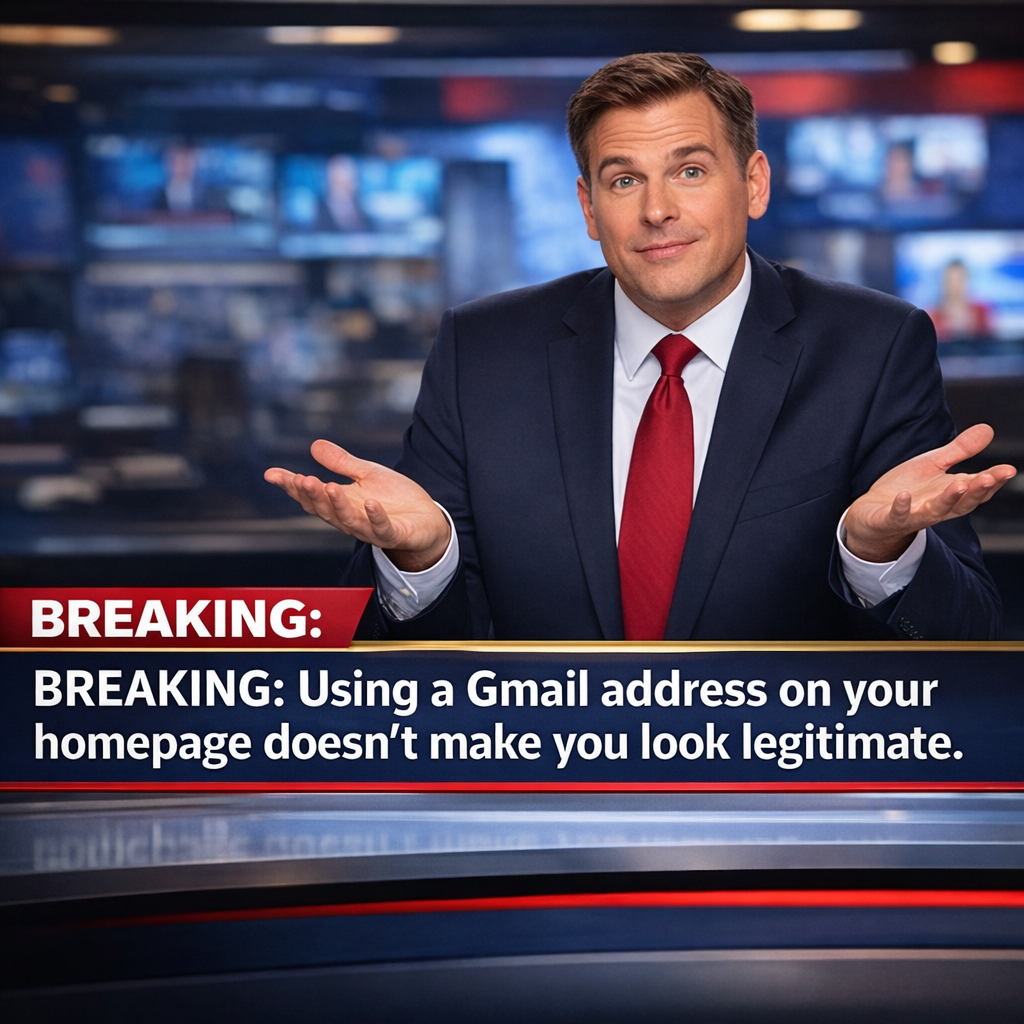
3. That Gmail address in your footer
Nothing undercuts professional authority faster than a free email address (e.g., [email protected]) on a commercial website. It implies you haven't invested in basic business infrastructure. Setting up a proper domain-based email (e.g., [email protected]) is a low-cost, high-impact change. In the B2B sector specifically, 65% of decision-makers view a branded email as a critical trust signal. It tells the user you're an established entity, not a hobbyist.
4. People don't know what to do next
A common failure in digital marketing is the absence of a primary Call to Action (CTA). If your user has to hunt for a phone number or a "Get a Quote" button, they will leave. This is known as "decision fatigue." Your site should have one clear, dominant goal per page. Whether it's "Book a Call" or "Buy Now," this button should use a contrasting color and appear repeatedly, once above the fold and again at the bottom of every section.
5. Too much stuff, nowhere to focus
Cognitive load refers to the amount of mental processing power required to use your site. When you clutter your navigation bar with 12 different tabs or fill your homepage with walls of text, you overwhelm the user. Hick's Law states that the time it takes to make a decision increases with the number and complexity of choices. A streamlined, mobile-first layout that prioritizes information hierarchy allows users to scan, understand, and act without mental exhaustion.
Why this hits harder in Clarence-Rockland
In a massive metropolis like Toronto, you might get away with a mediocre site because the volume of search traffic is enormous. In Clarence-Rockland and the wider Ottawa region, the market is tighter. Your digital reputation is inextricably linked to your offline reputation.
Local trust is a multiplier. If a neighbor recommends you, the first thing the prospect does is Google your name. If they find a broken, slow, or amateurish website, that warm lead turns cold instantly. In smaller communities, word-of-mouth drives traffic, but your website validates it. You're not just competing with algorithms. You're competing for the confidence of a community that talks. A polished online presence confirms that the rumors of your excellence are true.
What happens when trust comes first
When you prioritize trust over decoration, your website transforms from a digital brochure into a conversion engine. A trust-first approach relies on "Decision Architecture," structuring your content to answer the visitor's internal questions in a logical order.
Validation: "I'm in the right place."
Authority: "These people know their stuff."
Empathy: "They understand my problem."
Action: "Here's the solution."
By following this sequence, you lower the psychological barrier to entry. Metrics like bounce rate decrease, and "time on page" increases. More importantly, the quality of your leads improves because your content has already educated them on your process and value before they even pick up the phone.
You don't need to reinvent everything
Fixing these issues doesn't require a six-month marketing overhaul or a complete rebrand. It requires a shift in focus from "decoration" to "structure."
You don't need to rewrite every sentence or hire a film crew for video production. You simply need to organize your existing assets, your services, your testimonials, and your offers, into a framework that makes sense to a stranger. Clarity beats complexity every time. At EdenOS, we believe that a rigid, proven structure often outperforms a "creative" mess. By constraining your scope to what actually matters for conversion, you save time, money, and sanity while delivering a better experience for your user.
How we think about website structure
We reject the traditional agency model that drags on for months. Instead, we use a productized approach to website design in Clarence-Rockland. We believe your website should be treated like a product: defined scope, fixed price, and guaranteed delivery.
Our methodology focuses on mobile-first performance and clear Decision Architecture. We strip away the fluff that delays launches and focus strictly on the elements that drive revenue.
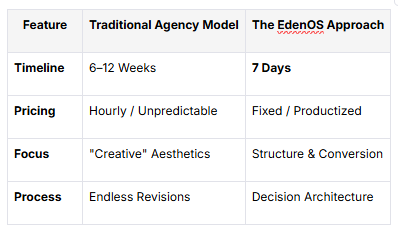
By standardizing the development process, we eliminate the "waiting game" and get your business converting traffic in exactly one week.
FAQ
How long should a small business website be?
A small business website doesn't need to be a novel. It needs to be concise enough to respect the user's time but long enough to answer their objections.
For most local service businesses, a single-page "scrollable" site or a compact 5-page structure (Home, About, Services, Reviews, Contact) is ideal. The goal is to provide just enough information to trigger a contact request. Long, rambling pages often dilute your core message and lower conversion rates.
Do I need advanced SEO right away?
You don't need an enterprise-level SEO campaign on day one, but your site must be built with "technical SEO" foundations to rank in Google eventually.
Advanced search engine optimization (backlinking, daily blogging) comes later. However, your initial build must have proper heading tags (H1, H2), fast loading speeds, mobile responsiveness, and local schema markup. Without these technical basics, no amount of future marketing will help you rank in Clarence-Rockland or Gatineau.
Can I use a template and still look professional?
Yes, but only if the template is customized heavily to match your brand identity and stripped of unnecessary code bloat.
The problem isn't the template itself. It's using it "out of the box" with generic stock photography and lorem ipsum text. A professional developer uses a framework (or "template") as a skeleton but skins it with unique typography, colors, and custom imagery to make it look legitimate and load instantly.
What makes a website look legitimate?
Legitimacy is visually communicated through consistency, high-quality imagery, and the absence of technical errors.
A legitimate site has a secure connection (SSL certificate), consistent fonts, professional (not blurry) image assets, and working links. It also displays real-world proof, such as a physical address in Canada, a local phone number, and verified customer testimonials. These signals tell the visitor that a real, accountable human team exists behind the screen.
Final thought: Trust Is the First Transaction
Before a customer gives you their money, they must give you their trust. Your website is the vehicle for that first transaction. If your digital presence in Clarence-Rockland looks neglected, customers assume your service will be too.
You don't need to be a technology expert to win online. You just need a structure that respects your visitor's intelligence and time. At EdenOS, we specialize in building these high-trust, low-friction digital foundations in just 7 days. If you're ready to stop losing leads to "fine" design, it's time to build a platform that actually converts.